


Alice Tapps White Jacob: Alleged Brothel-Keeper, and Landlady at the Globe Tavern

by Héloïse Sénéchal, 5 May 2026
In this blog post, Héloïse Sénéchal looks at new evidence identifying the woman who served drinks to theatregoers at the Globe tavern.
The second Globe playhouse had a least one tavern, but little is known about the people who operated it; the only individual documented working there is George White, identified in 1637 as ‘a vinner [vintner] at the Globe’.[1] I recently uncovered evidence placing the Globe tavern at a site close to the Thames and confirming that White was based there, rather than at the playhouse on Maid Lane (see this article). Circumstantial clues suggest that the riverside Globe was not an independent enterprise capitalising on the name of a more famous neighbour, but likely to have been connected to the King’s Men. Now, further archival findings allow us to identify the likely landlady at the tavern, and to document movement between the playhouse and the offsite drinking establishment.
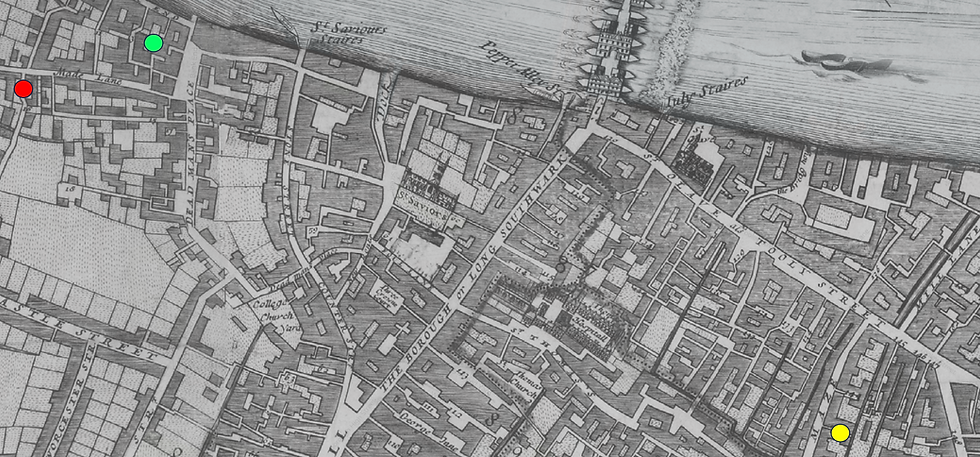
Map showing parts of the parish of St Saviour and the approximate locations of sites at which Alice can be placed: the Globe (red), the Globe tavern (green), and Goat Yard (yellow). William Morgan, Morgan’s Map of the Whole of London in 1682 (1682; detail), Layers of London, <https://www.layersoflondon.org/map/overlays/william-morgan-s-map-of-the-city-of-london-westminster-and-southwark-1682> Annotation mine.
Alice Tapps lived for at least a decade (1627-1637) on the border of, or possibly in the Globe playhouse precinct, in a housing cluster known known as Black Boy Alley. The dominant property there was the Globe-adjoining house, possibly called The Black Boy, to which the alley’s rental accommodation might have been affiliated.[2] It has long been assumed that this property, built and occupied until 1630 by King’s Men actor John Heminges, contained a tap-house, a plausible but as yet unproven scenario.[3] If so, the inhabitants of Black Boy Alley might have served as its staff or suppliers. Their occupations show that they certainly made the most of the stream of visitors to the theatre: Alice’s neighbours included victuallers, tobaccomen, brewers, and, according to parish authorities, several brothel-keepers. Her own household, too, was suspected of facilitating prostitution. In 1632, her husband Ralph was presented by St Saviour’s churchwardens for keeping ‘a disordered house & for entertayning lewd Company into his house and for keeping a house of bawdry as the comon fame [i.e. rumour] goeth’.[4] In 1636, he was in trouble again, alongside known victuallers and vintners, for ‘having company drinking’ in his house during the Sunday church service.[5] These records suggest that the couple were running a drinking establishment, perhaps an alehouse; if it was also operating as a brothel, it was not alone - a number of ale- and victualling-houses in the alleys surrounding Bankside’s early modern playhouses can be shown to have accommodated prostitution.

Woodcut showing a tavern scene. The Catalogue of Contented Cuckolds (1651-1686?), Magdalene College, Cambridge, Pepys Ballads 4.130, in English Broadside Ballad Archive, dir. Patricia Fumerton, EBBA 21794, <https://ebba.english.ucsb.edu/ballad/21794>.
When her husband died, aged fifty-two, in February 1636/7, Alice paid the 15s 4d funeral expenses and promptly remarried, on 11 April.[6] Her new husband was none other than George White, the Globe vintner, and Alice’s connection to him may have emerged from his professional affiliation to the playhouse - or even from her own, if the ‘house’ she ran with Ralph had been let or controlled by Heminges. She now moved to White’s property within the riverside site known as the Vine, home to the Globe tavern, and presumably worked alongside him selling drinks to those arriving for an afternoon’s leisure. Their marriage did not last for long, however: a mere eight weeks after the wedding, White was dead, buried in the local churchyard on 25 May. Alice spent the next four months at the tavern as a widow. On 27 September that year, she married for a third time, to another vintner, George Jacob, perhaps a colleague of White’s. The St Saviour token books, records of parishioners’ mandatory purchase of Easter communion tokens, show him joining Alice at the Vine property from 1638, where he was presumably also involved in running the Globe tavern. The numbers of tokens purchased by both the Whites and the Jacobs indicate that there was least one other (unnamed) person aged over sixteen in the household, perhaps an apprentice or other worker in the tavern; neither couple seems to have had any living children.
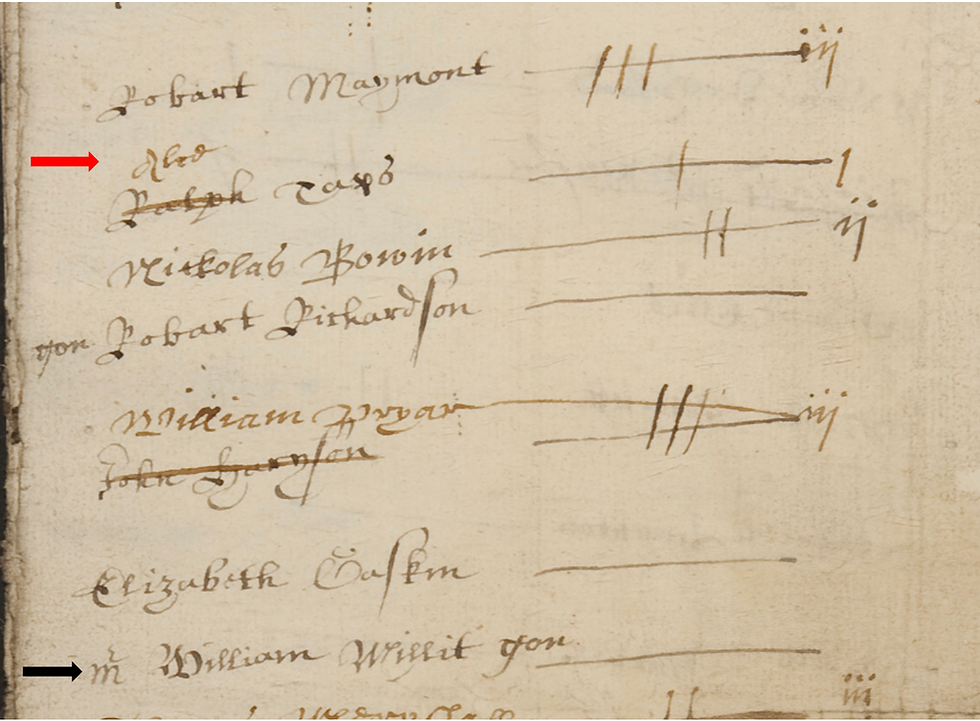
Entries in the 1637 Clink Liberty token book. ‘Alce Taps’ (red arrow) replaces her deceased husband, just three live households away from the Globe-adjoining house recently vacated by William Millet (black arrow), the tenant who moved in following Heminges’ death in 1630. TLA P92/SAV/286, 14, at William Ingram and Alan H. Nelson (eds), The Token Books of St Saviour Southwark, <https://tokenbooks.folger.edu/pdf/P92-SAV-286.pdf>.
Alice and George Jacob remained in the same token-book spot until late 1641 or early 1642, a suggestive departure date, given the growing Puritan influence that led to the closure of the theatres on 2 September 1642. They moved to Goat Yard, an impoverished area in the Boroughside sector of St Saviour, closer to London Bridge and the taverns and shops of the High Street. Their neighbours there included an alehouse-keeper, victualler, and cook, and they were still at that address is in 1644, when George witnessed the will of his neighbour William Webb (the cook).[7] The Jacobs’ marriage went on to last considerably longer than Alice’s union with the earlier Globe vintner: she was buried at St Saviour on 21 April 1669, and George on 19 March 1671/2. At the end of Alice’s life, her husband was in receipt of financial aid from the parish, probably due to age.
Alice’s footprint in the record is light. I have not found her maiden name or the record of her first marriage, although circumstantial evidence suggests this event occurred c.1626. Her name appears in the St Saviour token books once and by a very narrow margin: parish officials only noted the names of household heads in these records, generally husbands, fathers, or male employers. The brevity of Alice’s first widowhood leaves only a slim window for her deceased husband’s name to have been replaced with hers. Thereafter she appears, under differing married surnames, in two marriage entries in the parish register, and in the note of her burial; she is easy to miss with invariant or automated search parameters. Her years as a participant in the Globe’s entertainment economy are discernible by inference only, and her relationships with other members of that network largely invisible, although not entirely absent. The glimpse we catch of her moving from Black Boy Alley to the Vine is suggestive in reaffirming the linkage of the two sites, suggesting the imbricated economic and affective relationships between those working in the leisure industry. It also opens up further questions for consideration. Were Alice and her first husband working for Heminges and the King’s Men during their time in Black Boy Alley? Are multiple women implicitly present in the ‘house of bawdry’ and, if so, who were they? Can we capture other evidence of the movement of people between the relational Globe sites? These are issues I will be addressing as work on both the King’s Women and a separate project on the Bankside continues.
[1] The London Archives [TLA], P92/SAV/0521-0590, 548.
[2] Heloise Senechal, ‘The “dwellinge howse on the Banckside”: John Heminges and the Neighborhood of the Globe Playhouse’, Shakespeare Quarterly 76.1 (2025), pp. 14-45.
[3] For a summary of the evidence, see Gabriel Egan, ‘John Heminges’s Tap-House at the Globe’, Theatre Notebook 55.2 (2001), pp. 72-77.
[4] TLA P92/SAV/0521-0590, 524.
[5] TLA P92/SAV/0521-0590, 544.
[6] TLA P92/SAV/0731, 12, in William Ingram and Alan H. Nelson (eds), The Token Books of St Saviour Southwark <tokenbooks.folger.edu>.
[7] TNA PROB 11/193/110 [register copy].


Comments